

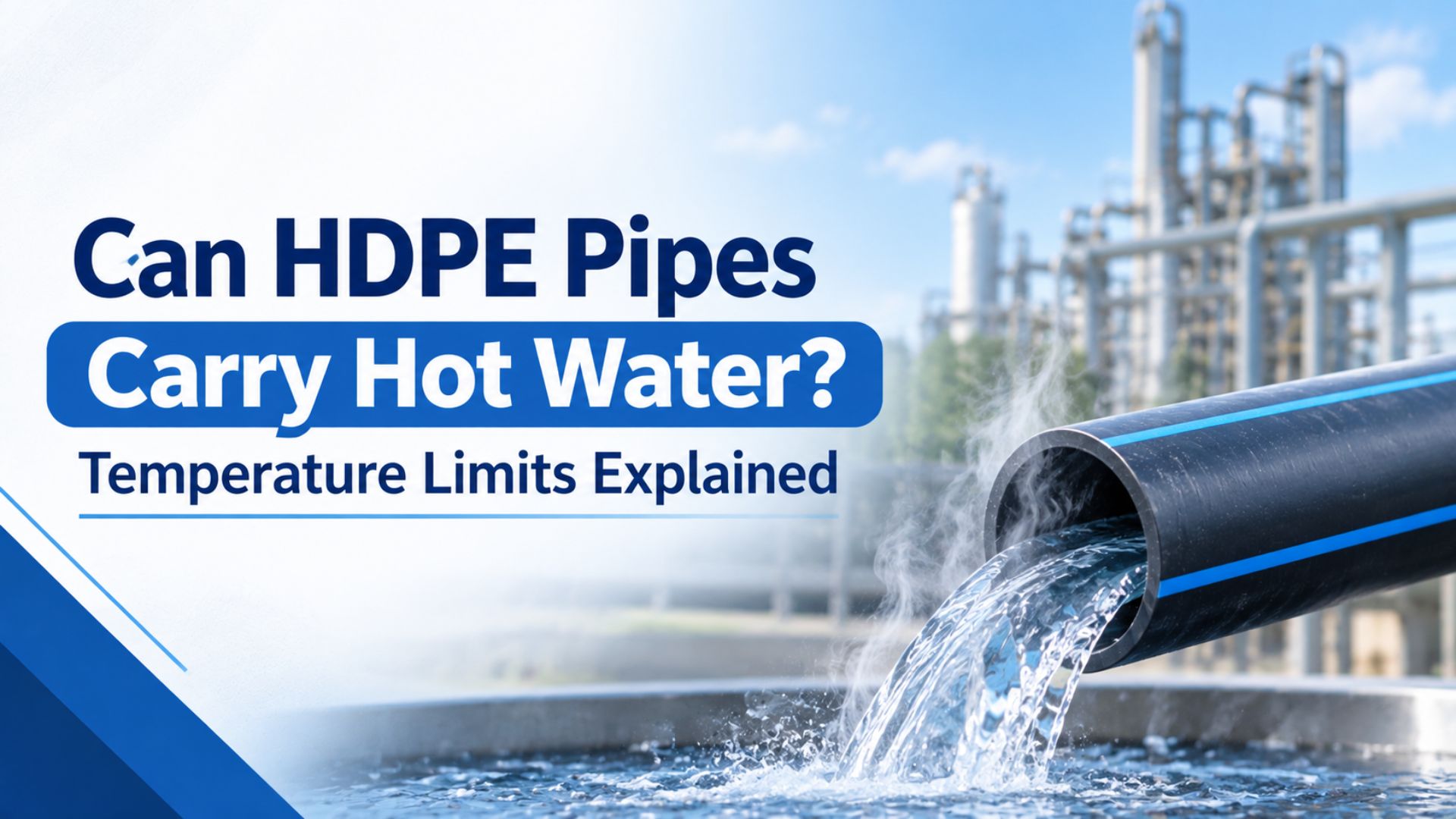
Somebody on site wants to run the geyser outlet through the leftover HDPE coil. Should you let them? Short answer: no. The HDPE pipe temperature limit for pressure water lines is about 45 °C under Indian Standard IS 4984, and the pipe loses pressure strength steadily as water warms up. HDPE is excellent for cold water. Hot water belongs in a different pipe.
What is the temperature limit of an HDPE pipe?
For pressurised water supply, treat 45 °C as the working ceiling for an Indian-standard HDPE pipe, and 60 °C as the absolute upper end for any HDPE pressure pipe worldwide. Above 60 °C, standard HDPE shouldn’t carry water under pressure.
Here’s how the different limits stack up:
| Limit | Temperature | Where it comes from |
| Recommended max water temperature (pressure use, India) | 45 °C | IS 4984 note on HDPE water pipes |
| Pressure rating (PN) reference temperature, India | 27 °C | IS 4984:2016 |
| Pressure rating reference temperature, Europe/ISO | 20 °C | ISO 4427 / EN 12201 |
| Upper limit for pressure service (international practice) | 60 °C (140 °F) | Plastics Pipe Institute (PPI) and US pipe manufacturers |
| Upper limit for gravity / non-pressure flow | about 82 °C (180 °F) | PPI-based manufacturer guidance |
| Lowest service temperature | –40 °C | IS 4984 and PPI |
So the full HDPE pipe temperature range is roughly –40 °C to 45 °C for Indian pressure water lines. The low end is never a problem in India. The high end is the one that catches people out.
Why does HDPE lose strength as water heats up?
HDPE is a thermoplastic. It doesn’t snap at a fixed temperature. It gets gradually softer, and under constant pressure, a softer pipe creeps (stretches slowly over time) until it bulges or splits. Every HDPE pipe’s pressure rating is calculated for 50 years at a reference temperature. In India that reference is 27 °C, which is why IS 4984 says PN ratings are “at 27 °C.” Run warmer water through the same pipe and its 50-year strength drops, so the safe working pressure has to come down too. Engineers call this pressure derating.
How much pressure does HDPE lose at higher temperatures?
The international derating factors for PE 100 (ISO 13761, used in EN 12201-1 Annex A) are measured against 20 °C:
The 50 °C value is from the 2024 edition of the European standard. The 60 °C value reflects US practice, where PE 4710 pipe rated 200 psi at 23 °C is rated 100 psi at 60 °C. Look at the 60 °C row. You’ve lost half your pressure capacity. A pipe bought as “PN 10” behaves like a PN 5 pipe, and a municipal line with a 6-bar surge can burst it. IS 4984 publishes its own pressure reduction coefficients, measured from 27 °C instead of 20 °C. For an Indian-standard pipe, use that table or the manufacturer’s data sheet, not the ISO numbers above. The trend is identical. Only the starting point moves.
Is HDPE pipe suitable for hot water?
No. Standard HDPE pipe isn’t suitable for domestic hot water lines: geyser outlets, solar water heater lines, kitchen and bathroom hot taps. Water from a geyser is usually set somewhere around 50–60 °C, and solar heaters can deliver hotter water still. That puts you right at, or over, the point where HDPE has lost half its strength. There’s a second problem. Hot water lines heat and cool many times a day. HDPE expands about 0.2 mm per metre for every 1 °C rise, which is far more than metal. A 10 m run heated from 25 °C to 60 °C grows about 7 cm. Repeated every day, that movement loads the joints and fittings. When people search for HDPE pipes for hot water, they’ve usually seen a pipe “survive” a hot connection for a few months. That doesn’t prove much. Creep failure is slow. The pipe can look fine for a year and then split at a joint.
What are the safe HDPE pipe hot water applications?
Some warm-water jobs are fine. The rule is: low temperature, or no sustained pressure.
Generally OK (with derating applied):
- Municipal and borewell water supply, which in most of India runs well under 40 °C
- Roof-tank-to-house lines, as long as the pipe is buried or shaded
- Drip and sprinkler irrigation
- Industrial cooling-water return lines below 40 °C, with derated PN
- Gravity drainage of warm water (non-pressure), where short hotter spells won’t harm it
Not OK:
- Geyser and solar heater outlet lines
- Hot water circulation loops in hotels, hospitals and hostels
- Boiler feed, condensate or steam lines
- Any line carrying more than 60 °C water under pressure
One Rajasthan-specific warning. Black HDPE laid on an open terrace absorbs a lot of sun. On a May afternoon in Jaipur, the pipe and the still water inside it can get far hotter than the 27 °C the PN rating assumes. Bury the line, run it in a shaded duct, or step up a pressure class for exposed runs.
What is HDPE pipe heat resistance at the material level?
HDPE pipe heat resistance has three thresholds, and only the first matters for a water line.
- About 45–60 °C: long-term service limit. Above this, creep under pressure shortens the pipe’s life. This is the number to design to.
- About 120–124 °C: Vicat softening point. Pipe-grade PE softens enough here that a needle sinks into it under a small load. US pipe data sheets list 248–255 °F.
- About 130 °C: melting point. The crystals in HDPE melt and it turns into a soft, rubbery mass.
At what temperature does HDPE degrade?
HDPE doesn’t chemically break down at hot-water temperatures. It physically weakens. True thermal degradation, where the polymer chains begin to oxidise and break, needs much more heat. That’s why butt fusion and socket fusion use heater plates at about 200–230 °C, but only for minutes. Leave HDPE at those temperatures for longer, or overheat it, and it oxidises and turns brittle. That’s also why IS 4984 tests the pipe’s oxidation induction time at 200 °C. For a water line, the useful answer is: HDPE starts losing long-term strength above 27 °C, shouldn’t carry pressurised water above 45–60 °C, softens at around 120 °C, and melts at about 130 °C.
Do HDPE pipe fittings have the same temperature limits?
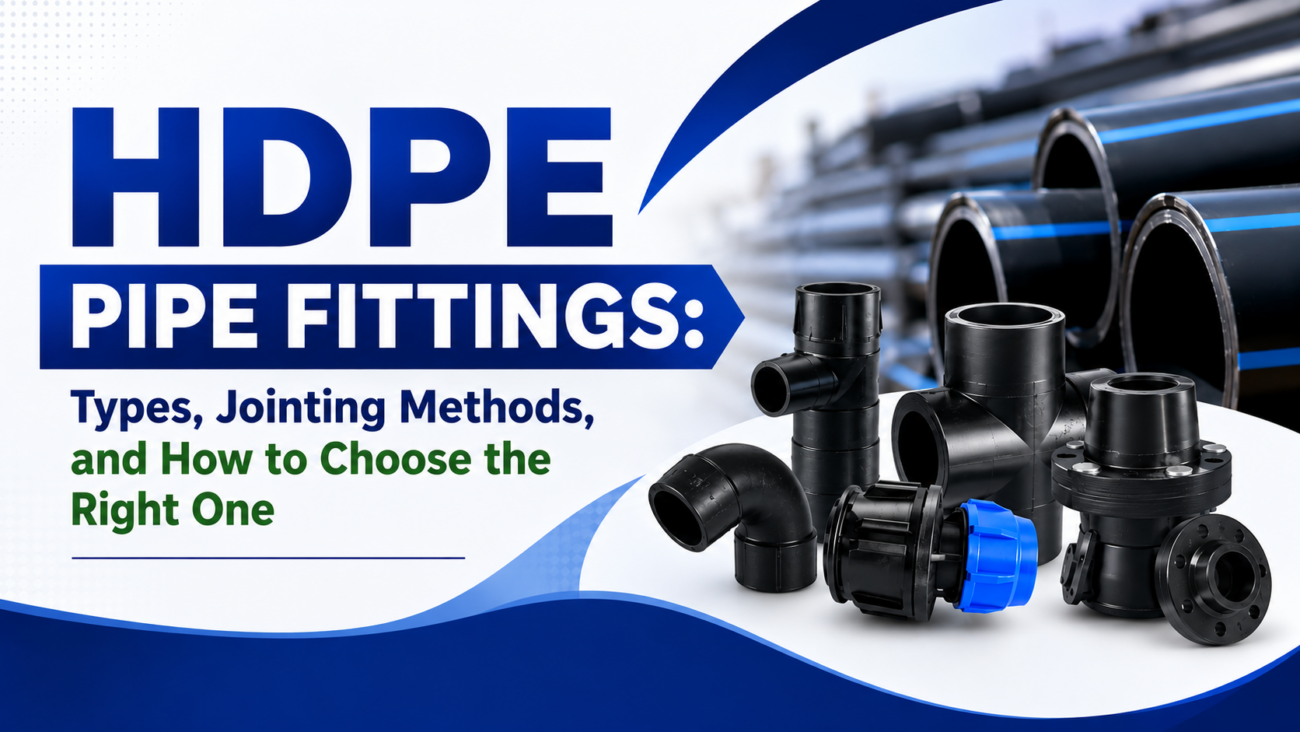
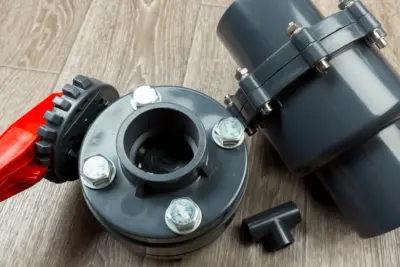
Yes. HDPE pipe fittings are moulded from the same PE 80 or PE 100 resin, so they derate exactly like the pipe. A pipeline is only as strong as its weakest component, which is usually a joint. If you derate the pipe for 40 °C water, derate the tees, bends, reducers and stub ends too. Mixed systems need extra care. A metal flange or brass compression fitting expands far less than the HDPE around it. In warm lines, that mismatch is where leaks start. Use matching-grade HDPE fittings with fused joints wherever you can.
HDPE vs PVC, CPVC and PPR: which pipe should you use?
Pick the pipe by water temperature first, then by pressure and laying method.
| Pipe | Hot water? | Typical safe use | Best for |
| HDPE (PE 80 / PE 100) | No | Up to 45 °C under pressure (IS 4984) | Water mains, borewell lines, FHTC house connections, irrigation, buried lines |
| uPVC | No | Cold water; pressure rated at 27 °C like HDPE | Cold plumbing, drainage, agriculture |
| CPVC | Yes | Rated for hot water up to about 82 °C under pressure (ASTM D2846) | Hot and cold plumbing inside buildings |
| PPR | Yes | Around 70 °C for long-term hot water service (ISO 15874 class 2) | Hot water lines, solar heater plumbing |
Which is better, PVC or HDPE?
Neither one is better across the board. Both are cold-water pipes. HDPE wins for buried and long-distance lines: it’s flexible, comes in long coils, joins by fusion with no solvent cement, and handles ground movement and impact far better than PVC. uPVC wins for rigid, exposed indoor runs, since it doesn’t sag between supports. For hot water, use neither. Go with CPVC or PPR.
Frequently asked questions
What are the temperature limits for HDPE pipes?
Under IS 4984, HDPE water pipes are recommended for a maximum water temperature of 45 °C and can be used down to an ambient –40 °C. Pressure ratings are calculated at 27 °C. Internationally, 60 °C is treated as the upper limit for pressure service, with roughly half the pressure rating left at that temperature.
Is HDPE pipe suitable for hot water?
No. Standard HDPE pipe isn’t suitable for domestic hot water from geysers or solar heaters. At 60 °C it keeps only about half its rated pressure, and daily heating and cooling stresses the joints. Use CPVC or PPR pipe for hot water lines and keep HDPE for cold water supply.
What are the disadvantages of HDPE pipes?
HDPE can’t carry hot water under pressure, expands a lot with heat, and needs fusion equipment and trained operators for joints. It can’t be solvent-cemented, sags on exposed runs without close supports, and needs thicker walls than PVC for the same pressure. It’s still the preferred pipe for buried cold water lines.
At what temperature does HDPE degrade?
HDPE begins losing long-term pressure strength above its 27 °C rating temperature and shouldn’t carry pressurised water above 45–60 °C. It softens at about 120 °C (Vicat point) and melts at about 130 °C. Chemical degradation by oxidation needs much higher heat, such as prolonged exposure near the 200–230 °C used for fusion welding.
Which is better, PVC or HDPE?
For buried water mains, borewell lines and house service connections, HDPE is usually better because it’s flexible, fusion-jointed and impact-resistant. For rigid exposed indoor plumbing, uPVC is easier to support. Neither is suitable for hot water. Choose CPVC or PPR for hot water lines.
Conclusion
Before you finalise a BOQ, write the maximum water temperature next to each line, then pick the pipe and PN class to suit it. For cold water mains, borewell and house connection lines, Arihant Plast in Jaipur has manufactured moulded HDPE pipe fittings for contractors since 1998. Call 9829010745 or email info@arihantplast.in for fittings matched to your pipe’s grade, SDR and pressure class.