


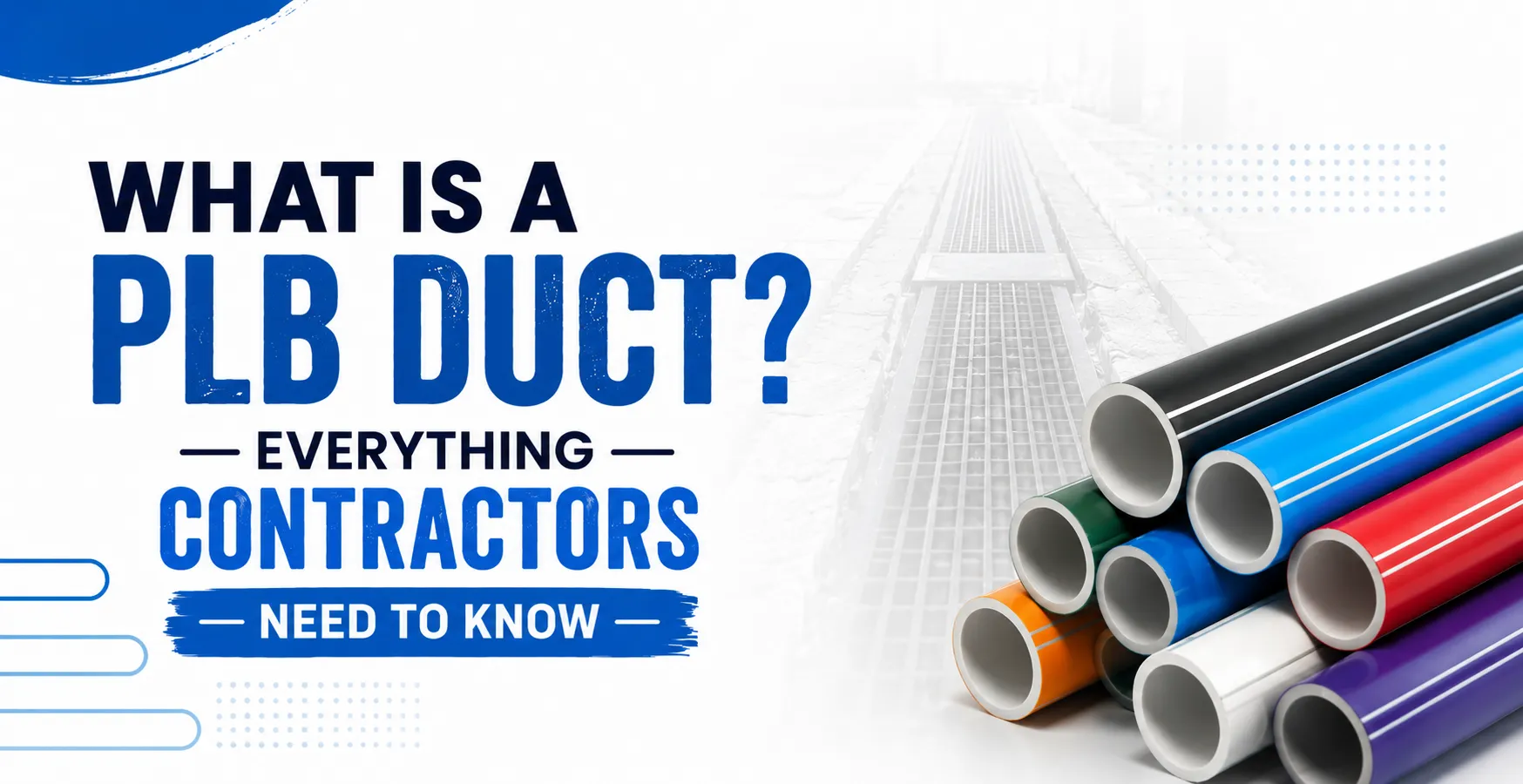
If you’ve worked on a fiber optic or telecom project lately, you’ve probably seen “PLB duct” pop up on a tender, a BOQ, or a site drawing. Maybe you nodded along and figured it out from context. But when a client asks you to quote the right duct, or an inspector checks whether you’ve used the correct grade, “I think it’s the orange pipe” doesn’t cut it.
This guide clears that up. By the end, you’ll know exactly what a PLB duct is, what the sizes and specs mean, which fittings you’ll need to order alongside it, and how to pick the right one so cable goes in smoothly and the job passes inspection the first time.
What Is a PLB Duct ?
A PLB duct is a permanently lubricated HDPE pipe used as an underground conduit to carry optical fiber cables. The “PLB” stands for Permanently Lubricated Bore, which describes the one feature that sets it apart: the inside of the pipe is slick by design, so fiber cable can be blown or pulled through it with very little friction.
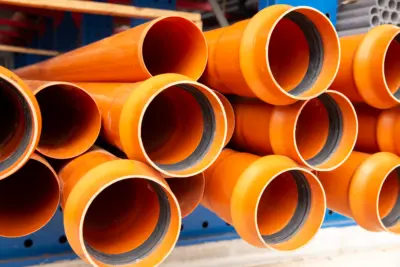
Think of it as a protective tunnel for fiber. The cable itself is fragile and expensive, so instead of burying it directly, crews bury the duct first and then push the cable through afterward. The duct shields the fiber from soil pressure, moisture, rodents, and the shovel of whoever digs there in ten years.
That’s the short version. The detail that actually matters on a job site is why it’s lubricated and how that changes your work, so let’s get into it.
Why “Permanently Lubricated” Is the Whole Point
Here’s where a PLB duct differs from an ordinary HDPE pipe. It’s made by co-extrusion, which means two layers are formed at once: a tough outer HDPE wall and an inner layer carrying a silicone-based lubricant. That lubricant is bonded into the pipe wall during manufacturing, not sprayed or smeared in afterward. So it doesn’t wash out, dry up, or wear away over the years.
Why does that matter to you? Because of how fiber gets installed. Crews use a cable-blowing method, where compressed air pushes the cable through the duct. A slick bore lets you blow cable in long, continuous runs, often well past a kilometer in a single shot. The Indian TEC specification caps the friction between the duct and the cable at a coefficient of 0.06, which is the technical way of saying “very slippery.” Less friction means fewer joints, less digging, and far less risk of damaging the fiber on the way in.
Cheap duct sold with a temporary gel coating might look identical on day one. A few months underground and that gel is gone, and your next cable pull turns into a fight. That’s the trap a genuine PLB duct is built to avoid.
Standard PLB Duct Sizes and Specifications
PLB duct is sized by outer diameter and inner diameter, written as OD/ID. So a “40/33” duct is 40 mm across the outside and roughly 33 mm across the bore.
Common PLB Duct Sizes
The sizes you’ll see most often on Indian projects are:
- 25/20 mm – small last-mile or in-building runs
- 32/26 mm – access network and shorter drops
- 40/33 mm – the workhorse size; the default for most backbone, BharatNet, and highway fiber jobs
- 50/42 mm – larger cables or multi-cable runs
- 63/50 mm – trunk routes, duct banks, and road or substation crossings
Larger sizes like 110/80 mm exist for heavy trunk work, and some makers offer in-between options such as 40/34.2 mm at a slightly lower cost. If you only remember one number, make it 40/33 since it covers the majority of standard installs.
Specs Worth Checking Before You Buy
Sizing is only half the story. A few other things separate a duct that passes inspection from one that gets rejected:
- Standard compliance. For telecom work in India, look for the current TEC Generic Requirement (TEC/GR/FA/CDS-008/04/AUG-19). Railway corridor work follows the RDSO specification instead. The base material should be virgin-grade HDPE conforming to IS standards like IS 4984.
- Coil length. Duct usually ships in 500 m or 1,000 m coils, with 200 m available too. Longer coils mean fewer joints across a run.
- Color and tracer stripes. Orange, green, blue, red, yellow, and grey are common, often with stripes so crews can tell networks apart underground.
- Printed markings. A compliant duct prints its maker, size, batch, date, and spec number along its length. No markings is a red flag.
Where PLB Ducts Are Used
PLB duct shows up anywhere fiber needs to travel safely underground. The big ones are telecom and broadband backbones, national programs like BharatNet, and 5G backhaul. Beyond that, you’ll find it under highways and city roads, alongside railway lines for signaling and information networks, and in power utility and smart-city cabling.
The common thread is protection plus easy future access. Because the duct is already in the ground, an operator can upgrade or add cable later by blowing new fiber through, with no fresh trenching. For asset owners, that’s the real selling point, and it’s worth mentioning when you quote a job.
PLB Duct Fittings and Accessories You’ll Need
A coil of duct on its own doesn’t finish an install. The duct fittings and accessories are what turn it into a sealed, continuous pathway, and forgetting them is a classic way to stall on site.
The core duct fittings you’ll order are:
- Push-fit couplers – join two duct lengths into an air- and water-tight connection so blowing pressure doesn’t leak. These are the pipe fittings you’ll use most.
- End caps – fitted on the duct ends during manufacturing and transport to keep dirt out.
- End plugs – seal empty duct ends before cable is installed.
- Cable sealing plugs – seal the ends again after the cable is in, blocking water, dust, and rodents.
- Bends and tees – route the duct around corners and branch points where needed.
These are plastic pipe fittings made specifically for cable duct, and that distinction matters. They look a little like the plumbing pipe fittings you’d find at a hardware shop, but they’re engineered to hold blowing pressure and keep a clean, snag-free bore. Standard plumbing pipe fittings aren’t rated for that and shouldn’t be substituted on a fiber job.
You’ll also want a few tools: a duct cutter for square cuts, a chamfering tool to bevel the edge so couplers slide on, and a C-spanner to tighten couplers properly.
How to Choose the Right PLB Duct and Avoid Costly Mistakes
A few practical pointers save the most headaches:
Match the size to the cable, with room to spare
Don’t pick the duct, then find a cable that barely fits. Confirm the fiber’s outer diameter first, then choose a bore that leaves comfortable clearance for blowing.
Insist on certification
Ask for the TEC or RDSO test certificate and batch traceability. On government and large private tenders, uncertified duct gets rejected, and reworking a buried route is brutal.
Don’t gamble on temporary lubrication
If a price looks too good, ask how the inner layer is made. Co-extruded and permanently bonded is what you want. Gel-coated duct fails you exactly when you need it most.
Buy fittings from the same family
Mixing odd couplers with a different brand of duct invites leaks. Order matching duct fittings and pipe fittings together.
Mind storage and color coding
Keep coils off direct ground contact and out of prolonged sun, and stick to a consistent color scheme so future crews can read your network at a glance.
Frequently Asked Questions
1.Is a PLB duct the same as an ordinary HDPE pipe?
Not quite. A PLB duct is made from HDPE, but it has a permanently lubricated inner layer that a standard HDPE pipe doesn’t. That low-friction bore is what makes long-distance cable blowing possible.
2.What is the most common PLB duct size?
The 40/33 mm size (40 mm OD, 33 mm ID) is the most widely used. It suits most backbone, highway, and BharatNet fiber installations.
3.Can a PLB duct be installed above ground?
It’s designed mainly for underground use, where the UV-stabilized outer wall and buried protection do their job. Short exposed sections are possible, but long above-ground runs usually call for additional mechanical protection.
4.What’s the difference between a PLB duct and a DWC pipe?
A PLB duct is a smooth, single-wall lubricated conduit for blowing fiber. A DWC (double-wall corrugated) pipe is a larger, ribbed conduit often used as an outer protective casing or for multiple sub-ducts. They’re frequently used together rather than as substitutes.
5.How deep should a PLB duct be buried?
Depth depends on the route and local rules, but cable ducts are typically laid below the frost and load zone, often around 1 to 1.5 meters under roadways. Always follow the project specification and local authority guidelines.
Conclusion
A PLB duct isn’t complicated once you strip away the jargon: it’s a tough, slippery-on-the-inside HDPE conduit that lets fiber cable go in fast, safely, and over long runs, then stay protected for decades. Get the size right, demand proper certification, and order the matching duct fittings, and you’ve removed most of the things that go wrong on a fiber job.
Planning your next project? Talk to a certified PLB duct supplier before you finalize your BOQ. Confirm the sizes, ask for the test certificates, and bundle your couplers, end plugs, and sealing plugs in the same order so nothing holds up the crew on install day. A few minutes of sourcing now saves days of rework later.