


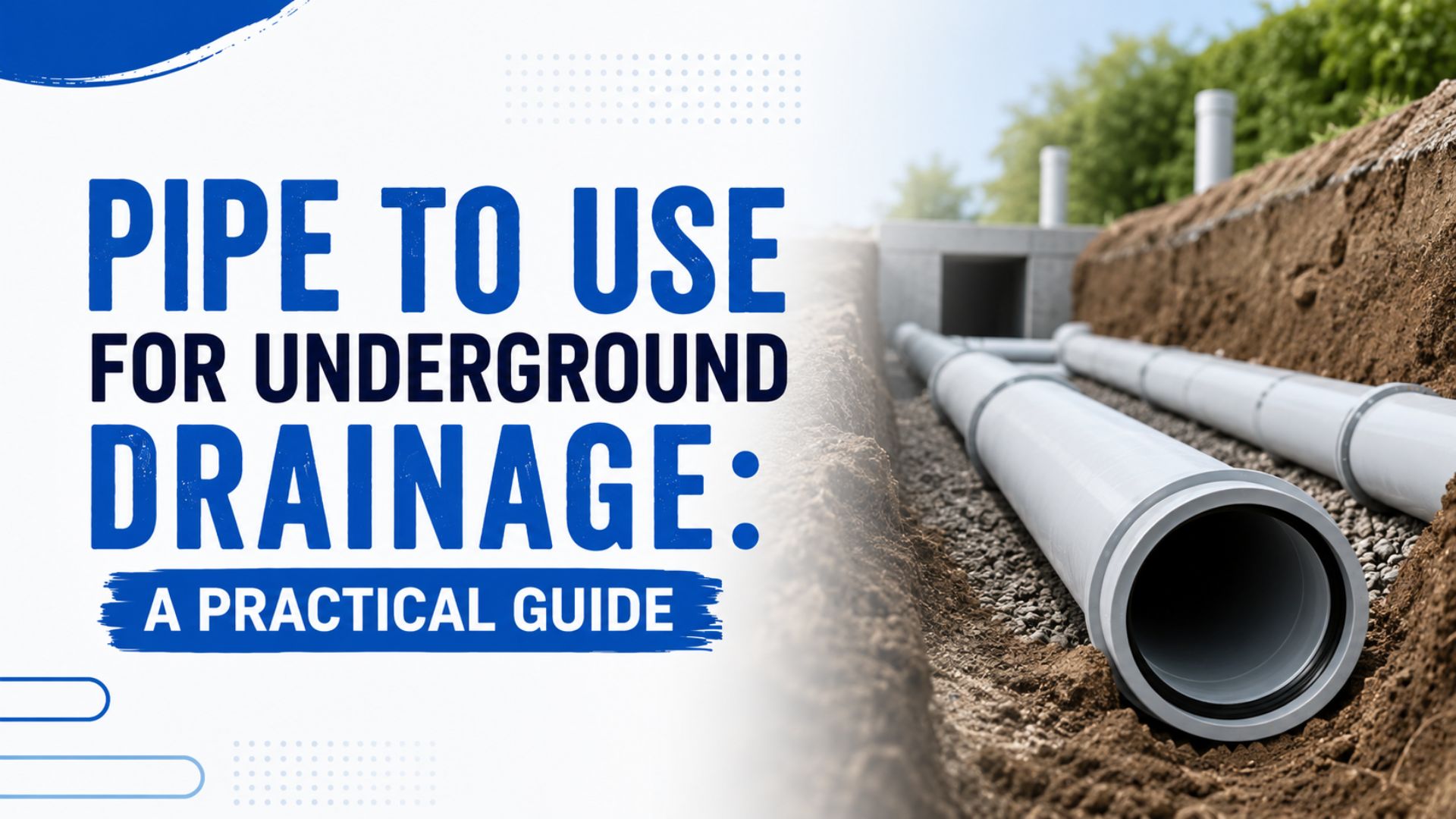
The first drainage failure I ever investigated was on a two-year-old building. Ground floor smelled of sewage after every heavy rain, and everyone blamed the plumber. It wasn’t the plumber. Someone had specified a light-duty pipe under a parking bay, the ground settled, the pipe ovalised, and the joint pulled apart about 1.4 metres below a slab nobody wanted to break.
That job cost more to fix than the entire original drainage line cost to lay.
This is the thing about buried pipe: the decision takes ten minutes, and you live with it for fifty years. So let’s make those ten minutes count. Below is how experienced engineers actually choose a type of pipe for underground drainage -the materials, the ratings that matter, how HDPE pipe fitting methods differ, and the mistakes that keep showing up on site.
Which Pipe Should You Use?
For most underground drainage today, HDPE pipe is the strongest all-round choice. It doesn’t corrode, it flexes with ground movement rather than cracking, and its heat-fused joints are effectively as strong as the pipe wall itself -which removes the single most common failure point in a buried line.
Match the pipe to the job like this:
- HDPE pipe (smooth wall) -sewer lines, pressurised drainage, deep or long runs, aggressive soils
- DWC HDPE (double-wall corrugated) -stormwater and sub-soil drainage, roads, high-flow gravity lines
- uPVC / SWR pipe -household waste and rainwater drains in stable soil, shallow depths
- RCC pipe -large-diameter municipal storm drains and culverts under traffic loads
- Stoneware (vitrified clay) -traditional gravity sewers; excellent chemical resistance, but brittle
- Ductile iron -high-pressure mains and river/road crossings where mechanical protection matters
If your soil moves, your effluent is corrosive, or digging it up later would be painful, choose HDPE.
Buy Now
Why Pipe Material Decides the Lifespan of the System
A buried pipe faces four pressures at once, and each one kills a different material.
Soil load and traffic. Rigid pipes resist load with their own wall strength. Flexible pipes like HDPE and uPVC transfer load into the surrounding soil, which means the backfill becomes part of the structure. That single distinction explains most installation failures -a flexible pipe in poorly compacted trench fill is a flexible pipe with no support.
Ground movement. Black cotton soil, hillside sites, reclaimed land, and areas with fluctuating water tables all shift. Rigid pipe cracks at joints. Flexible pipe deflects and recovers.
Chemistry. Sewage generates hydrogen sulphide, which converts to sulphuric acid at the crown of the pipe and eats concrete and unprotected metal. Coastal soils carry chlorides. Polyethylene shrugs off both.
Hydraulics. A rough interior traps solids. Over years, that’s the difference between a line you never think about and one that needs jetting every monsoon.Get these four right and you’ve prevented the large majority of drainage failures before the trench is even dug.
Types of Pipe for Underground Drainage: Full Comparison
| Type of Pipe | Best Application | Typical Life | Corrosion Resistance | Behaviour Under Movement | Relative Cost |
| HDPE (smooth wall) | Sewer, pressure drainage, deep runs | 50–100 yrs | Excellent | Flexible, recovers | Medium |
| DWC HDPE | Stormwater, sub-soil, road drainage | 50+ yrs | Excellent | Flexible | Medium |
| uPVC / SWR | Residential waste & rainwater | 40–60 yrs | Very good | Semi-rigid, can crack | Low |
| RCC (NP2–NP4) | Municipal storm drains, culverts | 50+ yrs | Moderate (attacked by H₂S) | Rigid, cracks | High |
| Vitrified clay | Gravity sewers | 80–100+ yrs | Outstanding | Brittle | High |
| Ductile iron | Pressure mains, crossings | 50+ yrs | Needs lining/coating | Rigid but tough | High |
| Cast iron (legacy) | Older buildings, stacks | 25–50 yrs | Poor -rusts | Rigid | High |
HDPE Pipe: Why It Became the Default
High-density polyethylene earned its position for one reason above all others -the joints. With butt fusion or electrofusion, two lengths of HDPE pipe become a single homogeneous run. There’s no gasket to perish, no adhesive bond to creep, no socket to pull apart under settlement. For anything buried deep or under a structure, that’s decisive.
Beyond jointing, HDPE offers a smooth bore (Manning’s n around 0.009–0.011, better than concrete’s typical 0.013), immunity to rust and most soil chemistry, and enough flexibility to survive ground movement that would fracture rigid pipe. It’s light, so long lengths can be handled without heavy plant, and it’s available in coils for smaller diameters, which cuts joint count dramatically.
Grades matter. PE 80 and PE 100 differ in minimum required strength, and PE 100 lets you use a thinner wall for the same pressure rating. For Indian projects, the relevant standards are broadly IS 4984 for polyethylene water supply pipes, IS 14333 for sewerage applications, and IS 16098 (Part 2) for structured-wall (corrugated) PE pipes. Always confirm the current revision with your supplier.
Read Also – What Types of Pipes are Used in a Borewell?
DWC HDPE: The Stormwater Specialist
Double-wall corrugated pipe is a clever piece of engineering -corrugated on the outside for ring stiffness, smooth on the inside for flow. You get structural strength without the weight of concrete.
Specify by ring stiffness class, not by “it looks strong”:
| Stiffness Class | Ring Stiffness | Typical Use |
| SN4 | 4 kN/m² | Landscaped areas, light-duty, shallow cover |
| SN8 | 8 kN/m² | Roads, driveways, vehicle loading, deeper cover |
Perforated DWC wrapped in a geotextile filter is the standard solution for sub-soil and French drains -it collects groundwater while keeping fines out.
uPVC and SWR: Fine, Within Limits
uPVC is cheap, light, and quick to install with solvent cement. For a shallow household drain in firm soil, it does the job for decades. Its limits are real though: it becomes brittle in cold conditions, degrades if stockpiled in sunlight before laying, and its socketed joints depend on rubber rings or cement bonds that are less forgiving of movement than fusion welds. Relevant standards include IS 4985 for uPVC pressure pipes and IS 13592 for soil, waste and rainwater applications.
RCC: Still the Answer for Big Storm Drains
For 600 mm diameter and above under carriageways, reinforced concrete (classes NP2 to NP4 under IS 458) remains hard to displace on cost per metre. It’s immensely strong. But it’s heavy, needs machinery, has rougher hydraulics, and sulphide attack is a genuine long-term concern in sewage applications unless it’s lined or sulphate-resisting cement is used.
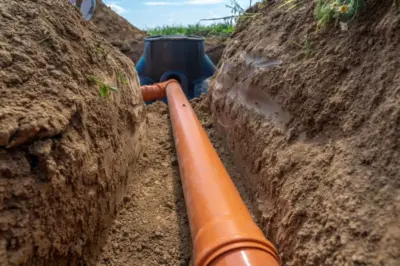
HDPE Pipe Fitting: The Part That Actually Fails
You can specify perfect pipe and still lose the system at the joints. Here’s how the main HDPE pipe fitting methods compare.
| Jointing Method | How It Works | Best For | Watch Out For |
| Butt fusion | Pipe ends heated, pressed together, fused | Same-diameter, same-grade pipe ≥ 63 mm | Contamination, wrong heat/pressure, rushed cooling |
| Electrofusion | Coupler with embedded wire heats and fuses | Tight trenches, repairs, tie-ins | Pipe must be scraped and clean; needs power |
| Compression fittings | Mechanical grip and seal | Small diameters, temporary work | Not equal to fused strength; check torque |
| Flanged joints | Stub end plus backing ring, bolted | Connections to valves, pumps, other materials | Bolt sequence and gasket seating |
| Mechanical / transition | Adaptors to PVC, DI, or steel | Mixed-material systems | Correct adaptor rating for the pressure |
Three field rules I’d give any site engineer:
- Scrape, don’t wipe. Electrofusion requires the oxidised outer skin removed with a proper scraper. A rag and solvent alone will produce a joint that looks perfect and leaks in year three.
- Respect the cooling time. Moving or backfilling a butt-fused joint before it has fully cooled under clamp pressure is the most common cause of weak welds.
- Never mix incompatible grades or SDRs blindly. Fusing dissimilar wall thicknesses without the correct fitting produces a joint with an unpredictable stress profile.
Sizing and Gradient: The Quiet Half of the Job
The right type of pipe at the wrong slope still blocks. Gravity drainage needs enough velocity for self-cleansing -around 0.7 m/s is the usual target.
| Pipe Diameter | Typical Minimum Gradient | Notes |
| 100 mm | 1 in 40 | Standard for household soil lines |
| 150 mm | 1 in 60 to 1 in 80 | Common for building connections |
| 225 mm | 1 in 90 to 1 in 100 | Branch sewers |
| 300 mm+ | 1 in 100 to 1 in 150 | Depends on flow and design velocity |
Counter-intuitively, too steep is also a problem. Water outruns the solids, leaving them stranded in the invert. Steady and correct beats dramatic.
Installation Practices That Decide the Outcome
- Build the bedding. 100–150 mm of compacted granular material under the pipe. Never lay directly on rock or lumpy excavated spoil.
- Haunch it properly. Compact material into the springing zone on both sides -that’s where a flexible pipe gets its load capacity.
- Backfill in layers. 150–300 mm lifts, compacted evenly on both sides so the pipe isn’t shoved sideways.
- Keep cover depth right. Too shallow under traffic and you’ll deform the pipe; check the manufacturer’s minimum for the stiffness class.
- Install chambers and cleanouts at junctions and long straight runs. Access is cheaper than excavation.
- Test before covering. Air or water testing takes an hour. Finding a leak after the driveway is poured takes a week.
Final Word
Choosing the right type of pipe for underground drainage isn’t really a materials question -it’s a risk question. Ask what the ground will do, what’s flowing through, what’s driving overhead, and how hard it would be to reach that line again in twenty years. Answer those honestly and the material usually picks itself, which for most modern projects means HDPE with properly executed HDPE pipe fitting.
Then give the installation the same respect as the specification. Correct bedding, compacted haunching, the right gradient, accessible chambers, and a test before backfill will do more for longevity than any upgrade in material grade.
Planning a drainage line? Have a qualified drainage engineer confirm your diameter, gradient and stiffness class against your actual site conditions, and buy pipe and fittings from a certified supplier who can support the jointing method you’ll use on site. Ten minutes of specification now saves an excavation later.
Frequently Asked Questions
Which pipe is best for underground drainage?
It resists corrosion and chemical attack, flexes with ground movement instead of cracking, and its fusion-welded joints eliminate the weak point where buried drains usually fail. For large municipal storm drains, RCC remains cost-effective at bigger diameters, while uPVC suits shallow residential drains in stable soil.
What is the best material for underground drain pipe?
High-density polyethylene (HDPE) is generally the best material, offering a 50–100 year service life, excellent chemical resistance and a smooth bore that resists clogging. For stormwater and sub-soil collection specifically, double-wall corrugated HDPE (SN8 under traffic) is the standard choice because it combines high ring stiffness with efficient flow.
What type of pipe should I use for an underground water line?
Use HDPE pipe for buried water supply lines. It’s rated for pressure, won’t corrode or scale, and heat-fused joints mean no buried connections that can leak. Choose PE 100 grade with a pressure rating suited to your system, confirm it’s certified for potable water, and use electrofusion or butt fusion rather than mechanical fittings for buried sections.
Which is the best drainage pipe company in India?
There’s no single “best” -the right supplier depends on diameter, application and standard required. India has several well-established piping manufacturers producing ISI-marked HDPE, DWC and uPVC drainage pipes, including names such as Supreme Industries, Astral, Finolex, Prince Pipes, Ashirvad and Jain Irrigation. Judge any supplier on four things: valid ISI/BIS certification against the correct IS code, the exact stiffness or pressure class you need, availability of matching certified HDPE pipe fitting components, and technical support for fusion welding on site. Verify current certifications directly before ordering.
Which pipe is better for drainage, HDPE or PVC?
HDPE is better where conditions are demanding -moving ground, corrosive effluent, deep burial, heavy loads, or long runs where a future leak would be expensive to reach. PVC is better where the job is simple: shallow residential drains in stable soil, where its lower cost and quick solvent-cement installation are genuine advantages. Durability favours HDPE; upfront cost and simplicity favour PVC.