


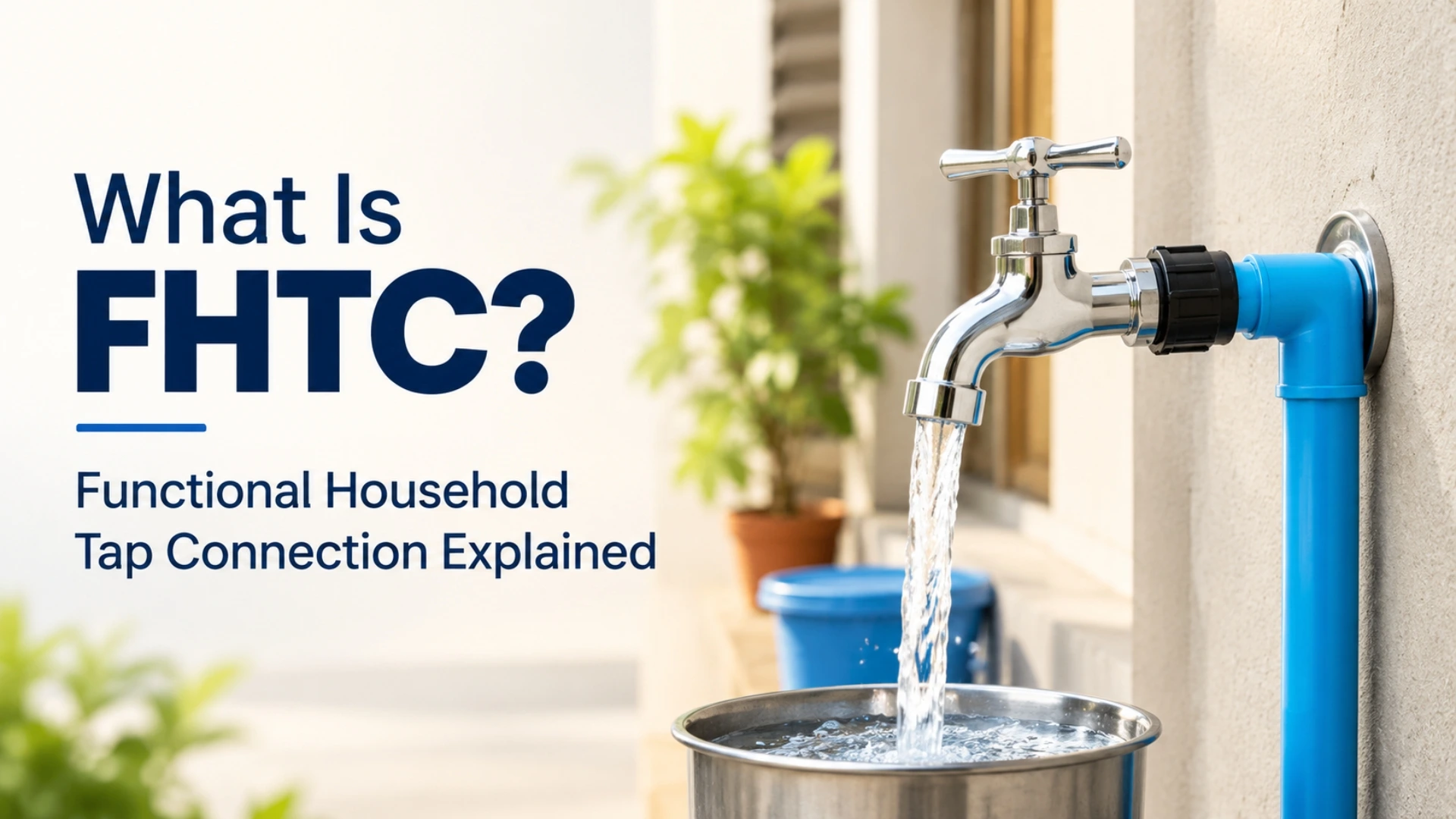
Your village has a new pipeline and a tap outside every house. But the water comes for twenty minutes, the tap leaks, and nobody is quite sure who fixes what. Here’s what FHTC means, what parts make up your connection, and how to keep it working for years.
What is FHTC?
FHTC stands for Functional Household Tap Connection. Under the Jal Jeevan Mission, a household counts as having an FHTC only when its tap supplies at least 55 litres of water per person per day, of drinking quality that meets the BIS 10500:2012 standard, on a regular, long-term basis.
That word “functional” matters. A tap fixed to a wall with no water coming out isn’t an FHTC. Neither is a tap that runs brown water, or one that works for a month and then dries up. The goal is dependable drinking water at home, so women and children don’t have to walk to a handpump or a village tank.
Buy Now
What is the Jal Jeevan Mission (Har Ghar Jal)?
Jal Jeevan Mission (JJM), also called Har Ghar Jal, is the central government’s programme to give every rural household in India a working tap connection. It was launched on 15 August 2019.
A few numbers from the Press Information Bureau (March 2026):
- 15.80 crore rural households had tap connections, about 81.61% of all rural homes.
- The Union Cabinet extended the mission to December 2028 under what’s now called JJM 2.0.
- The focus has shifted from laying pipes to making sure the water keeps flowing: local maintenance, water-quality testing and community ownership of each scheme.
For you, that shift is good news. The question now isn’t only “does my house have a tap?” It’s “does my tap work every day?”
What parts make up an FHTC house connection?
An FHTC house connection is the short line that takes water from the village distribution pipe in the lane to the tap at your home. It usually has five or six parts, and each one does a specific job.
| Part | What it does | Why it matters to you |
| Service saddle | Clamps onto the main pipe in the lane so a hole can be tapped safely | A poor saddle leaks at the main and wastes water for the whole lane |
| Brass ferrule | Screws into the saddle and controls the opening into your line | It sets how much water can enter your connection |
| Connecting pipe | Carries water from the lane to your house, commonly a 20 mm HDPE or MDPE pipe | Buried properly, it lasts decades without rusting |
| Flow control valve (FCV) | Limits the flow so every house gets a fair share | Stops homes near the tank from taking more than their share |
| Adapter (MTA/FTA) and elbow | Joins the plastic pipe to the threaded tap or stand post | A weak adapter is a common leak point |
| Tap (brass or PTMT) | Where you actually collect water | Used several times every day, so quality shows fast |
Some schemes also fit a water meter, especially where the Pani Samiti charges by use.
How does a flow control valve keep water fair for every house?
A flow control valve limits how much water can pass through your connection each minute, whatever the pressure in the main pipe. Without it, the first few houses near the overhead tank get a strong flow and the last houses in the village get almost nothing.
This is the part people most often tamper with, and it’s a mistake. Removing the FCV might give your house a stronger flow for a few days. It also starves your neighbours at the tail end, and it’s one of the main reasons schemes fall apart after the first year.
Read Also – 7 Factors to Check Before Buying Industrial Pipe Fittings
Who pays for an FHTC and who maintains it?
The government and the state share most of the cost of the scheme. The community also contributes: under JJM guidelines, villages put in 10% of the in-village capital cost, or 5% in hilly, North Eastern and Himalayan areas and in villages where more than half the population belongs to Scheduled Castes or Scheduled Tribes. This can be paid in cash, kind or labour.Day-to-day running is handed to the Pani Samiti, also called the Village Water and Sanitation Committee (VWSC). It has 10 to 15 members, at least half of them women. The samiti usually collects a small monthly water charge, and that money pays for repairs, a pump operator and replacement parts.
In Rajasthan, the Public Health Engineering Department (PHED) implements JJM. If your village has no connection yet, or your connection has stopped working, start with your Pani Samiti or Gram Panchayat. They can take it to the PHED office.
What goes wrong with FHTC connections, and how can you prevent it?
Most FHTC failures start with small, cheap parts at the house end, not the big pipeline. These are the most common problems, and what you can do about each.
Leaking taps and adapters
A tap that drips all day wastes water around the clock and turns the ground by your door into mud. Replace a worn washer as soon as you notice it. If the tap body itself is cracked, replace it with an ISI-marked tap rather than the cheapest one at the local shop.
Low pressure or no water at your house
If your neighbours get water and you don’t, the likely culprits are a blocked ferrule, a crushed pipe under a path, or a faulty FCV. Report it to the samiti. Don’t dig up the line yourself.
Pumps pulling water from the line
Some households fit a small electric pump straight onto their tap line. It feels like a quick fix for low pressure, but it sucks water away from everyone further down the pipe and can pull dirty water into the line through loose joints. Don’t do it, and tell the samiti if you see it.
Farm use of the drinking water line
This matters especially in farming villages. Your FHTC is sized for drinking, cooking and bathing. It is not meant for irrigation or cattle sheds. Running a hose to your field from the house tap drains the supply for the whole village. Use a separate irrigation connection or your own borewell line for the farm.
Broken or buried connection pipes
Tractors, trolleys and new construction often crush connection pipes that were buried too shallow. Know where your line runs, and ask for a protective sleeve where it crosses a path or road.
How can you tell if your FHTC fittings are good quality?
Good FHTC fittings carry an ISI mark with an IS number and a CM/L licence number, which you can check in the free BIS Care app. That’s the quickest way to separate a real certified part from a lookalike.Beyond the mark, look for a few things. Plastic fittings should have clean, even threads and no rough edges. Brass ferrules and taps should feel heavy and solid. And the pipe should be printed with its size and pressure class.Contractors choose most parts for a JJM scheme. You can still make sure your replacements are just as good. Arihant Plast makes FHTC house connection fittings, including saddles, ferrules and flow control valves, at its factory in Jaipur and has supplied pipe fittings since 1998.
Frequently asked questions
What is the full form of FHTC?
FHTC stands for Functional Household Tap Connection. It’s the term used under the Jal Jeevan Mission for a household tap that supplies at least 55 litres per person per day of safe drinking water on a regular basis.
How much water should an FHTC supply?
Under the Jal Jeevan Mission, an FHTC should supply at least 55 litres per person per day of water that meets the BIS 10500:2012 drinking water standard. Some states set higher service levels.
Is an FHTC connection free?
The government funds most of the cost, but villages contribute 10% of the in-village capital cost (5% in hilly, North Eastern and SC/ST-majority villages) in cash, kind or labour. Most Pani Samitis also collect a small monthly water charge to pay for maintenance.
Who do I contact if my FHTC tap is not working?
Start with your village Pani Samiti (Village Water and Sanitation Committee) or Gram Panchayat. In Rajasthan, they can escalate problems to the Public Health Engineering Department (PHED), which implements the Jal Jeevan Mission in the state.
Can I use my FHTC connection for irrigation?
No. An FHTC is designed for household drinking, cooking and washing. Using it for fields or livestock takes water away from other homes on the same line and can cause the whole scheme to fail.
Keep your connection working
An FHTC only counts if water flows every day. Fix small leaks quickly, leave the flow control valve alone, and use ISI-marked replacement parts. If you’re a Pani Samiti member, contractor or dealer looking for FHTC fittings, call Arihant Plast in Jaipur on 9829010745 or email info@arihantplast.in.