

Ask ten pipeline crews which HDPE joining method they trust most, and the answer usually depends on whichever machine is sitting in the back of their truck. I’ve watched a 400 mm water main go together in a trench barely wide enough to kneel in -and watched another crew burn half a day wrestling a welding rig into a space it was never designed for.That’s the honest starting point for the electrofusion vs butt fusion question. Neither method is universally superior. Both, done properly, create a joint that is chemically one piece of polyethylene -as strong as the pipe wall itself. What separates them is where they work well, what they cost per joint, and how much room for operator error they leave behind.
Quick Answer
Butt fusion is usually the better choice for long, straight runs of medium-to-large diameter HDPE pipe, because it needs no fitting and the cost per joint stays low. Electrofusion is better in tight trenches, for repairs, small diameters, tie-ins and awkward geometry, since the fitting controls the heat and alignment. Both produce a fully fused, leak-free joint when the procedure is followed.
What Is HDPE Butt Fusion?
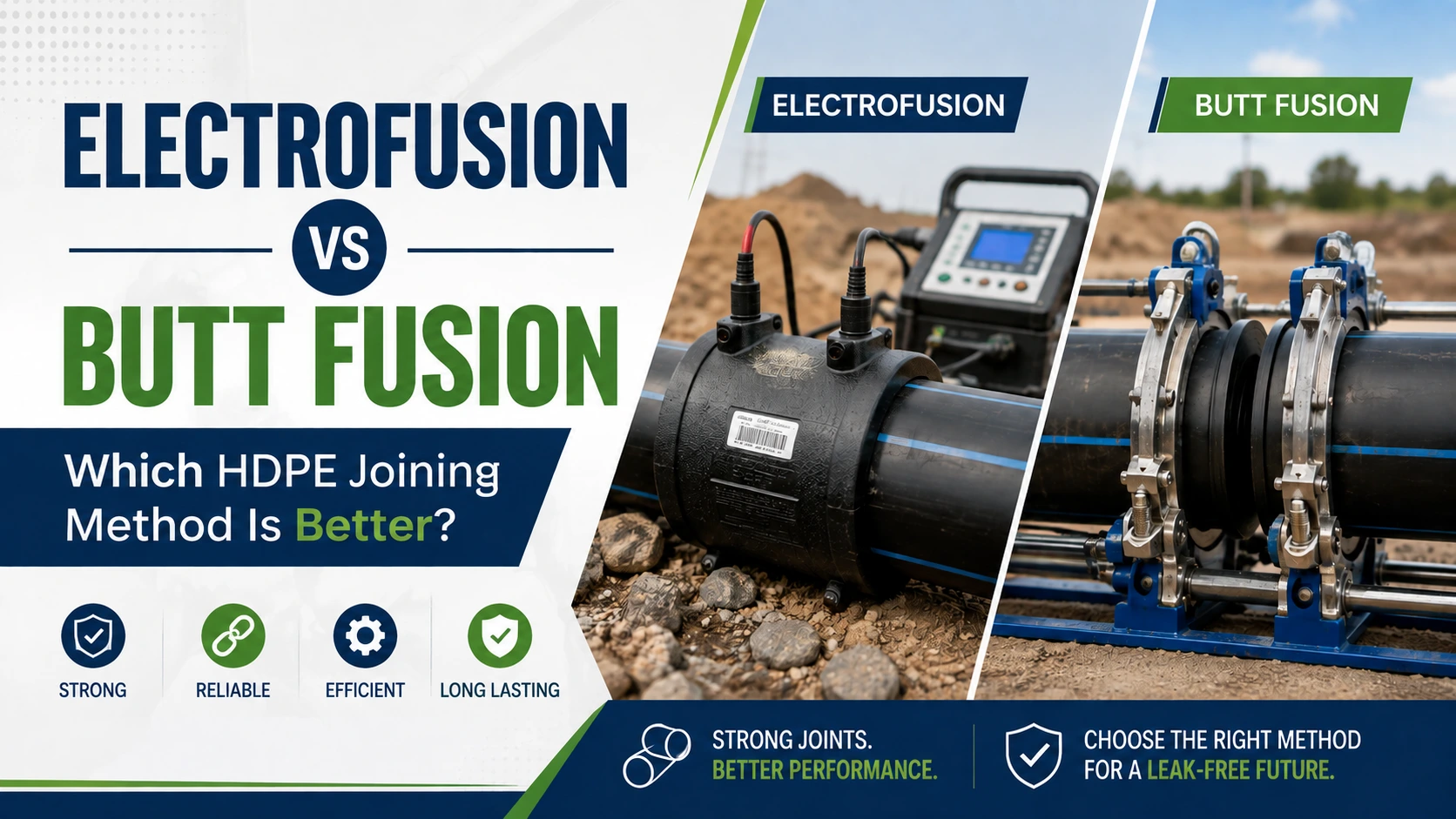
HDPE butt fusion joins two pipe ends directly, with no coupler in between. The ends are clamped in a machine, faced flat, checked for alignment, then pressed against a heated plate held at 400–450°F (204–232°C) -425°F is the common working set point under ASTM F2620. Once the melt bead forms and soaks, the plate is pulled and the ends are brought together under an interfacial pressure of 60–90 psi, then held while they cool for a minimum of 11 minutes per inch of wall thickness.
That cooling window is where most butt fusion joints are won or lost. Break clamp pressure early and you get a joint that looks perfect and fails a bend-back test.Governing standards: ASTM F2620, ISO 21307, and DVS 2207-1 in European practice.
What Are HDPE Electrofusion Joints?
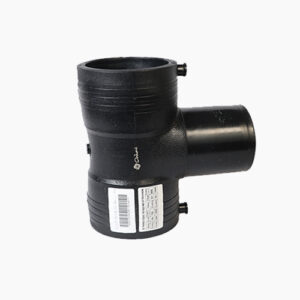
An electrofusion joint uses a moulded fitting -a coupler, tee, elbow or tapping saddle -with a resistance coil embedded just under its inner surface. The pipe is scraped to remove the oxidised skin, wiped with isopropanol, clamped in alignment, and the control unit reads the fitting’s barcode and delivers a preset voltage (commonly around 39.5 V) for a preset time. Heat radiates outward from the coil, the interface melts, thermal expansion generates internal pressure, and the two surfaces fuse.The critical detail people underestimate: electrofusion pipe fittings don’t fix bad preparation, they hide it. Unscraped oxidation or a smear of mud is sealed inside the joint where nobody can see it.
Governing standards: ASTM F1055, ISO 8085-3 and EN 12201-3.
Electrofusion vs Butt Fusion: Head-to-Head Comparison
| Factor | Electrofusion | Butt Fusion |
| Heat source | Resistance coil inside the fitting | External heater plate |
| Fitting required | Yes -cost rises sharply with diameter | No -pipe joins pipe |
| Practical size range | 20 mm – 630 mm (larger available, expensive) | 63 mm – 1600 mm and above |
| Trench space needed | Minimal | Substantial -machine must straddle the joint |
| SDR / wall mismatch | Tolerant within limits | Must match wall thickness exactly |
| Power demand | Low; generator-friendly | Higher; hydraulics plus heater |
| Alignment sensitivity | Low -clamps and fitting control it | High -misalignment is a rejectable defect |
| Skill dependency | Preparation discipline | Full procedural skill |
| Traceability | Excellent -data logged per joint | Machine-dependent (DataLogger units) |
| Cost per joint (large dia.) | High | Low |
| Typical cycle time | 1–40 min fusion + cooling | Faster per joint in production runs |
When to Use Each Method
Both HDPE pipe joining methods appear on the same drawings all the time. Here’s how experienced designers split them:
| Scenario | Recommended method | Why |
| Long-distance water or sewer main | Butt fusion | No fitting cost across hundreds of joints |
| Repair clamp or damaged section cut-out | Electrofusion | No axial movement possible in a live line |
| Gas distribution, 32–180 mm | Electrofusion | Traceability and tight-space performance |
| HDD or pull-in strings | Butt fusion | Smooth outside profile, no protruding coupler |
| Tie-in to existing buried pipe | Electrofusion | Handles restraint and slight ovality |
| Chamber and pit work | Electrofusion | Machine simply won’t fit |
| Industrial process lines, 315 mm+ | Butt fusion | Economics and speed |
What Experienced Crews Actually Weigh
After two decades around HDPE fusion techniques, three things decide the method more often than any spec sheet:
Diameter economics. Below roughly 110 mm, electrofusion often wins outright -the coupler is cheap and setup is fast. Above 315 mm, coupler prices climb steeply while the plate-welded joint stays flat in cost. Somewhere in the 160–250 mm band the curves cross, and that crossover is worth calculating for your own project rather than assuming.Trench reality. A hydraulic frame needs working room on both sides of the joint. If the design has valve chambers, congested services or shored narrow trenches, the method chooses itself.Weather and dirt. Plate welding is more forgiving of a damp, dusty site because the melt faces are shaved clean seconds before joining. Electrofusion demands scraped, dry surfaces -rain running down a pipe into a coupler is a genuine failure mode.
FAQs
Which HDPE electrofusion machine is the best for professionals?
There’s no single winner -the right unit depends on the fitting range and site conditions. Professionals typically look for a barcode scanner with manual override, an ambient temperature sensor that auto-corrects fusion time, generator tolerance down to around 170 V, and onboard joint data logging with USB or Bluetooth export. Established names in this space include Hürner, Georg Fischer, Plasson, Ritmo and Fusion Group. Match the output rating to your largest planned coupler and confirm the machine is certified to ISO 12176-2.
What is the best fusion welding machine for HDPE pipe?
Choose by diameter band first. For 63–315 mm work, a compact hydraulic butt fusion machine is the practical sweet spot; beyond 500 mm you need a heavy hydraulic frame with four-jaw clamping and a facer that can handle the wall. McElroy, Ritmo, Rothenberger and Wuxi-built machines all serve different price points. If your contracts require traceability, buy a data-logging model from the start -retrofitting is rarely worth it.
What are HDPE electrofusion joints?
They are joints formed using a polyethylene fitting with an internal electric heating coil. Current passing through the coil melts the fitting’s inner surface and the pipe’s outer surface simultaneously, fusing them into one continuous material once cooled. They’re widely used in gas and potable water networks because the fusion cycle is machine-controlled and fully recordable.
Is an electrofusion joint stronger than a butt fusion joint?
Neither is inherently stronger. Both are designed to exceed the pipe’s own hydrostatic rating, so a correctly made joint of either type fails outside the weld, not at it.
Conclusion
The electrofusion vs butt fusion decision is a logistics and economics question dressed up as a technical one. Straight runs need no butt fusion fittings at all, which makes it the cheapest way to build long pipelines. Electrofusion buys access, control and a data trail in the places a machine simply cannot go.Most well-run projects don’t pick one. They spec plate welding for the mainline and keep electrofusion couplers on the truck for everything the drawings didn’t predict.