


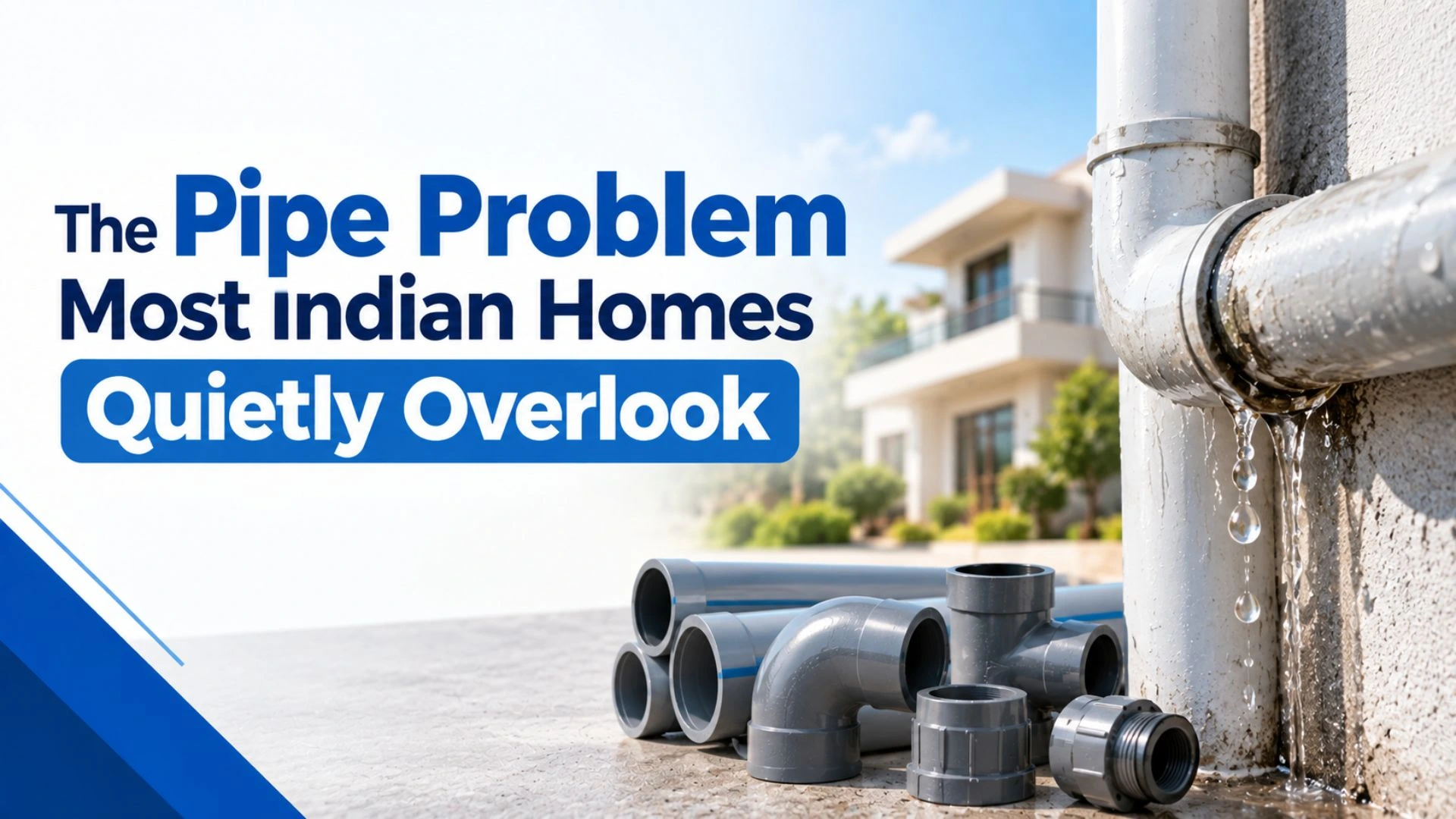
That damp patch under the bathroom tiles. The kitchen tap that’s never quite stopped dripping. The water bill that crept up for no clear reason. Most plumbing pipe problems in home water systems don’t start with a burst. They start the day someone saves a few rupees on a fitting without an ISI mark.
We make and supply pipe fittings at Arihant Plast, and this is the problem we hear about most often. It isn’t bad luck, and it isn’t always a bad plumber. It’s a cheap part hidden inside a wall, doing a job it was never tested for.
What is the pipe problem most homes overlook?
The problem is non-ISI pipes and fittings: parts made without Bureau of Indian Standards (BIS) certification, installed behind walls and under floors where nobody sees them again. They look almost identical to certified parts on the shop counter. The difference shows up two or three years later, as a slow leak, a cracked elbow or a tap that won’t seal.
Here’s why it gets overlooked. Pipes and fittings are usually the last line on a construction or renovation budget, and they’re bought in bulk by a contractor, not chosen by you. You pick the tiles, the basin and the geyser. Nobody asks you which brand of elbow goes into the wall.
Why do non-ISI fittings cause plumbing pipe problems in home lines?
A fitting only has to do one thing: hold water at pressure, for years, without moving. Non-certified parts fail at that for a few predictable reasons.
- Filler-heavy or recycled plastic. Cutting the virgin resin with fillers or reprocessed material brings the price down. It also makes the fitting brittle, especially once it’s been through a few summers.
- Thin, uneven walls. A certified fitting has to meet minimum wall thickness and dimensions. An uncertified one only has to look right.
- Loose threads and poor tolerances. If a thread doesn’t mate cleanly, the plumber adds extra Teflon tape and hopes. That joint is where your leak will start.
- Wrong material for the job. uPVC used on a hot water line from the geyser will soften and sag. It wasn’t designed for that heat.
None of these faults are visible on the day of installation. A new joint almost always holds. The question is whether it still holds in year five.
What does a hidden leak actually cost you?
More than the part ever saved. The US Environmental Protection Agency’s WaterSense programme estimates that a tap leaking at one drip per second wastes more than 3,000 gallons a year. That’s roughly 11,000 litres, from a single drip.
Inside a wall it gets worse, because you can’t see it. A concealed leak shows up late, as:
- Seepage and peeling paint on the other side of the wall
- Hollow-sounding or loose floor tiles in the bathroom
- Fungus and a musty smell in cupboards that back onto a wet wall
- An overhead tank that empties faster than it should
- Rusting of the steel in the slab, in the worst cases
Fixing any of these means breaking tiles, replacing the fitting, re-plastering and repainting. The labour and finishing work can easily cost many times the price of the original part. We’d go as far as saying this: saving money on fittings is the most expensive shortcut in a home build.
Which Indian standards should your pipes and fittings meet?
Every certified pipe or fitting is made to a specific Indian Standard, printed on the product next to the ISI mark. These are the ones you’re most likely to find in a home:
| Product | Where it’s used at home | Indian Standard to look for |
| CPVC pipes | Hot and cold water lines, geyser connections | IS 15778 |
| uPVC pipes | Cold water supply only | IS 4985 |
| HDPE pipes | Main water line, borewell line, underground runs | IS 4984 |
| HDPE moulded fittings | Joints on HDPE lines | IS 8008 |
| Plastic taps and valves (PTMT) | Bib taps, pillar taps, angle and stop valves | IS 9763 |
You don’t need to memorise this table. Just check that the IS number printed on the product matches what it’s being used for. An IS 4985 pipe on your geyser line is a mismatch, even if it carries a genuine ISI mark.
How can you check whether an ISI mark is genuine?
Look for three things printed together: the ISI mark, the IS number and a licence number that starts with CM/L. Then verify that licence number in the free BIS Care app. A logo on its own proves nothing, because it’s easy to copy.
Here’s the full check. It takes about two minutes per product.
- Find the marking. On pipes it’s printed along the length. On fittings and taps it’s moulded into the body or printed on the pack.
- Read the IS number. Match it to the product type using the table above.
- Note the CM/L number. This is the manufacturer’s BIS licence.
- Open the BIS Care app. It’s free on Android and iOS, in Hindi and English. Go to Verify Licence Details and enter the CM/L number.
- Match the details. The app shows the licence holder and the product it covers. If the name or product doesn’t match what’s in your hand, don’t use it.
If you find a fake ISI mark, you can report it through the Complaints section of the same app.
Where should you never compromise on fittings?
If the budget is tight, spend it where a failure is hardest to reach. These spots matter most:
- Concealed bathroom and kitchen lines. Anything behind tiles is expensive to reach later.
- The geyser and hot water line. Heat is where weak plastic fails first. Use CPVC made for hot water.
- The main incoming line and service connection. This carries full supply pressure, often underground.
- The overhead tank outlet and inlet. A failed joint up there can flood the terrace or empty the tank overnight.
Frequently asked questions
Is it illegal to sell pipe fittings without an ISI mark?
It depends on the product. Some products are under compulsory BIS certification and others aren’t, and the list changes over time. What is always illegal is printing a fake ISI mark on a product that has no BIS licence.
How long should good-quality pipes and fittings last?
Certified plastic plumbing systems are designed for decades of service when they’re used within their rated pressure and temperature. The real life depends on correct material choice and proper installation.
Can I use uPVC pipes for hot water?
No. uPVC pipes made to IS 4985 are meant for cold water. For geysers and hot water lines, use CPVC pipes made to IS 15778.
How do I know if there’s a hidden leak in my wall?
Watch for damp patches, peeling paint, hollow-sounding tiles or a water meter that keeps moving when every tap is closed. A plumber can confirm it with a pressure test or a moisture meter.
What is a CM/L number on an ISI mark?
The CM/L number is the manufacturer’s licence number from the Bureau of Indian Standards. You can enter it in the BIS Care app to check who holds the licence and which product it covers.
Build it once, build it right
You’ll only see your pipes the day they’re installed. After that, you’re trusting them for the next twenty years. Spend two minutes checking the ISI mark on each type before the walls close.
Need ISI-marked taps or pipe fittings, or bulk pricing for a project? Talk to the Arihant Plast team and we’ll help you pick the right part for each line.