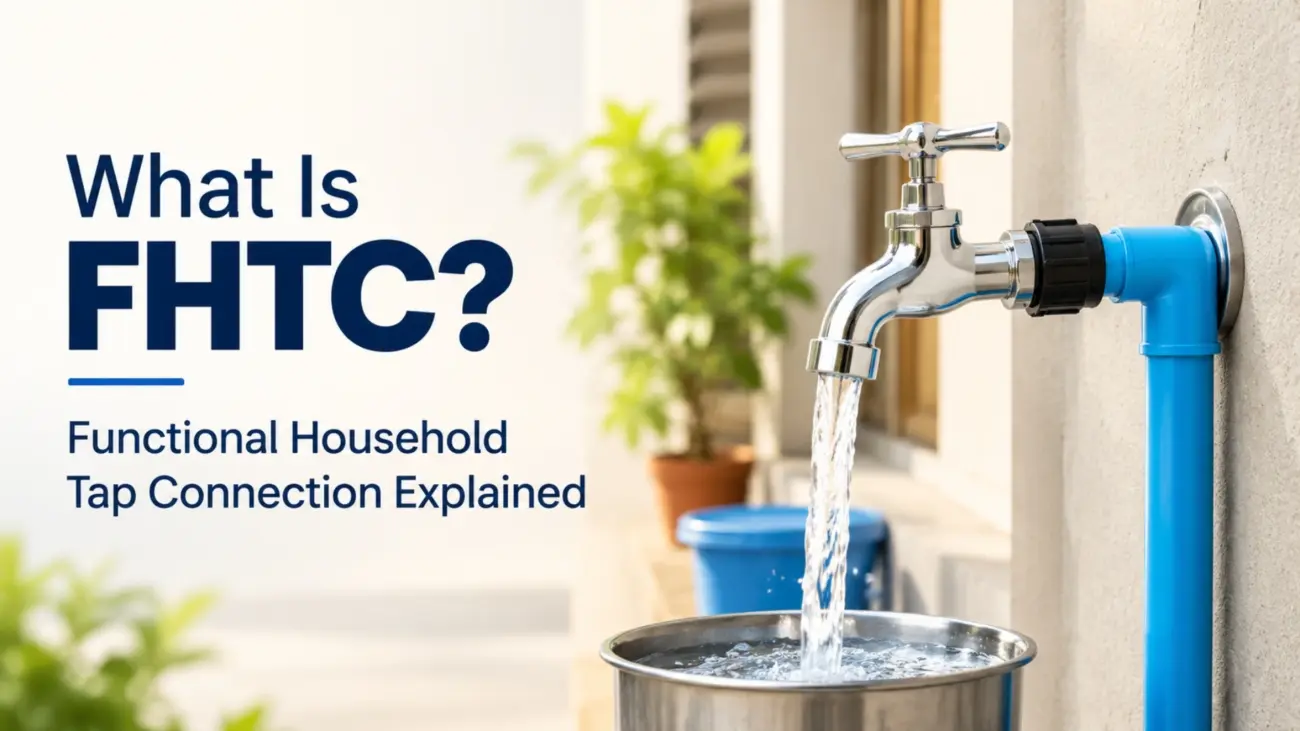



A crew is digging outside your gate and nobody has explained what happens next. That’s a common experience with FHTC installation. The work at your doorstep is a small, well-defined job, and knowing its stages helps you spot a bad connection before it costs you months of dry taps. This guide covers the FHTC connection process, the fittings involved, and the mistakes that matter.
What Is a Functional Household Tap Connection (FHTC)?
A Functional Household Tap Connection is a tap inside your premises that delivers safe drinking water in adequate quantity, regularly. Under Jal Jeevan Mission, the benchmark is 55 litres per capita per day, meeting the BIS 10500 quality standard. The word “functional” matters. A connection that fails on any one of these dimensions is classed as non-functional. A tap that exists but runs dry still doesn’t count. The scale is large. As of July 18, 2026, about 15.89 crore of India’s 19.36 crore rural households, or 82.09 per cent, were reported to have tap water at home. Most households that haven’t received a connection yet will go through the process described below.
FHTC Fittings: What Goes Into a House Connection
Classic house service connections follow a fixed sequence of parts. The sequence runs from the ferrule through the gooseneck and service pipe to the stop cock and water meter. Rural schemes vary by state, but the logic is the same.
| Fitting | What it does | What to check |
|---|---|---|
| Ferrule (or tapping saddle) | Joins the service pipe to the distribution main | Seated firmly, no weeping at the joint |
| Gooseneck | Flexible curved piece that absorbs ground movement | No kinks or sharp bends |
| Service pipe | Carries water from the main to your premises | Correct material per scheme spec, laid away from drains |
| Stop cock / valve | Lets you isolate your supply | Reachable without digging |
| Water meter (where the scheme uses one) | Measures consumption | Arrow points along the direction of flow |
| Riser and tap | The outlet inside your premises | Fixed firmly to a support, not just the pipe |
Good FHTC fittings are rarely the weak point. Poor workmanship around them is.
FHTC Installation Steps
Your role is mostly to confirm, inspect and document. The scheme’s contractor or the department does the technical work. Here is the FHTC connection process in order.
1. Confirm your household and the tap location
Check with your Gram Panchayat or village water committee that your household is on the list. Agree where the tap will sit inside the premises. Each functional tap connection is meant to be linked to the Aadhaar number of the head of the household, subject to statutory provisions, so keep that document handy.
2. Make sure the distribution line is ready
The street main should be laid, tested and ideally charged with water before anyone connects houses to it. Connecting to a dead line only means you’ll find the faults later.
3. Mark the route and dig the trench
The service pipe should take the shortest practical path from the main to your premises. It should be laid in a trench that carries no sewage or drainage pipe. Insist on this. Contamination usually starts here.
4. Fix the ferrule or tapping saddle on the main
This is the contractor’s job. Don’t allow improvised joints or a hole drilled in the main with a loose fitting jammed in.
5. Lay the service pipe
The gooseneck and service pipe go in next. Bed the pipe evenly so it isn’t strained, and make sure it isn’t resting on sharp stones.
6. Fit the stop valve, meter and tap
Install the stop valve in an accessible spot. If a meter is used, flush the line before fitting it and set it so the arrow on the body points in the flow direction. Finish with the riser and tap.
7. Flush, test, backfill and record
Run the water until it’s clear, check every joint for leaks, then backfill. Only after that should the connection be marked complete. State, district and village-level status of tap connections is publicly available on the mission dashboard, so you can check that yours has been recorded.
Who Is Responsible for What?
| Stage | Household | Contractor / scheme | Panchayat / committee |
|---|---|---|---|
| Eligibility and tap location | Provides details | Notes location | Verifies list |
| Main connection and service pipe | Inspects | Executes | Monitors |
| Tap, valve and riser | Checks quality | Installs | Signs off |
| Ongoing upkeep | Reports faults | Fixes warranty issues | Coordinates operations |
Mistakes That Cause FHTC Connections to Fail
- Skipping the flush test. Debris left in the pipe clogs the tap or meter within weeks.
- Running the pipe beside a drain. It’s cheap to avoid and expensive to fix.
- Burying the stop valve. The first leak becomes an excavation job.
- Ignoring pressure at the end of the line. If houses at the tail end get a trickle, the problem is usually the main, not your fitting.
- Accepting “done” without a working tap. Ask to see water flowing before anyone signs off.
Practical Tips Before You Sign Off
Take dated photos of the trench, the joints and the finished tap. They are useful if a dispute comes up later. Run the tap at different times of day for a few days, because morning flow often hides evening pressure drops. Keep the contractor’s contact details and any warranty note somewhere safe.
Know the standard the connection is judged on. Coverage and functionality are different things. A 2024 government-commissioned survey found that nearly 98% of surveyed rural households had tap connections, yet only about three-quarters received reliable, safe water. A tap on the wall is the beginning of the service, not the end of it.
FAQs
What does FHTC stand for?
FHTC stands for Functional Household Tap Connection. It means a working tap in your home that supplies safe water in adequate quantity on a regular basis.
Who does the FHTC installation work?
The scheme’s contractor or the water supply department does the technical work, supervised by the local Gram Panchayat or village water committee. Households should not hire private plumbers for the main connection.
How long does an FHTC connection take?
The actual household connection is short once the street main is ready. The wait is usually for the distribution network, so timelines depend on your village’s scheme.
Do I pay for an FHTC connection?
This varies by state and scheme, so ask your Gram Panchayat or state water department for current rules instead of relying on hearsay.
What if my tap connection stops working?
Report it to your village water committee or Gram Panchayat first. If nothing happens, escalate to the block or district water supply office.
Conclusion
Good FHTC installation is mostly about discipline: a tested main, a clean trench, accessible fittings and a flush test before sign-off. Insist on seeing water run and keep your photos. If you want to know where your village stands, check the public mission dashboard.