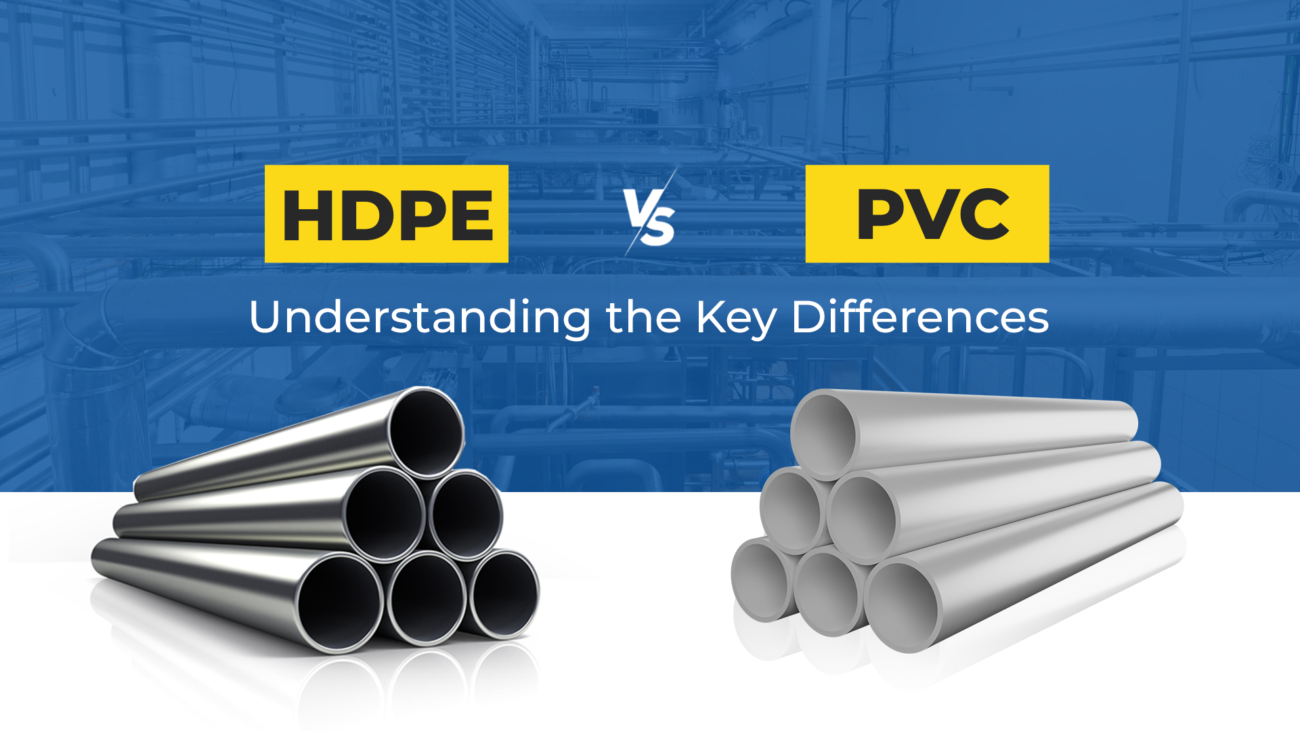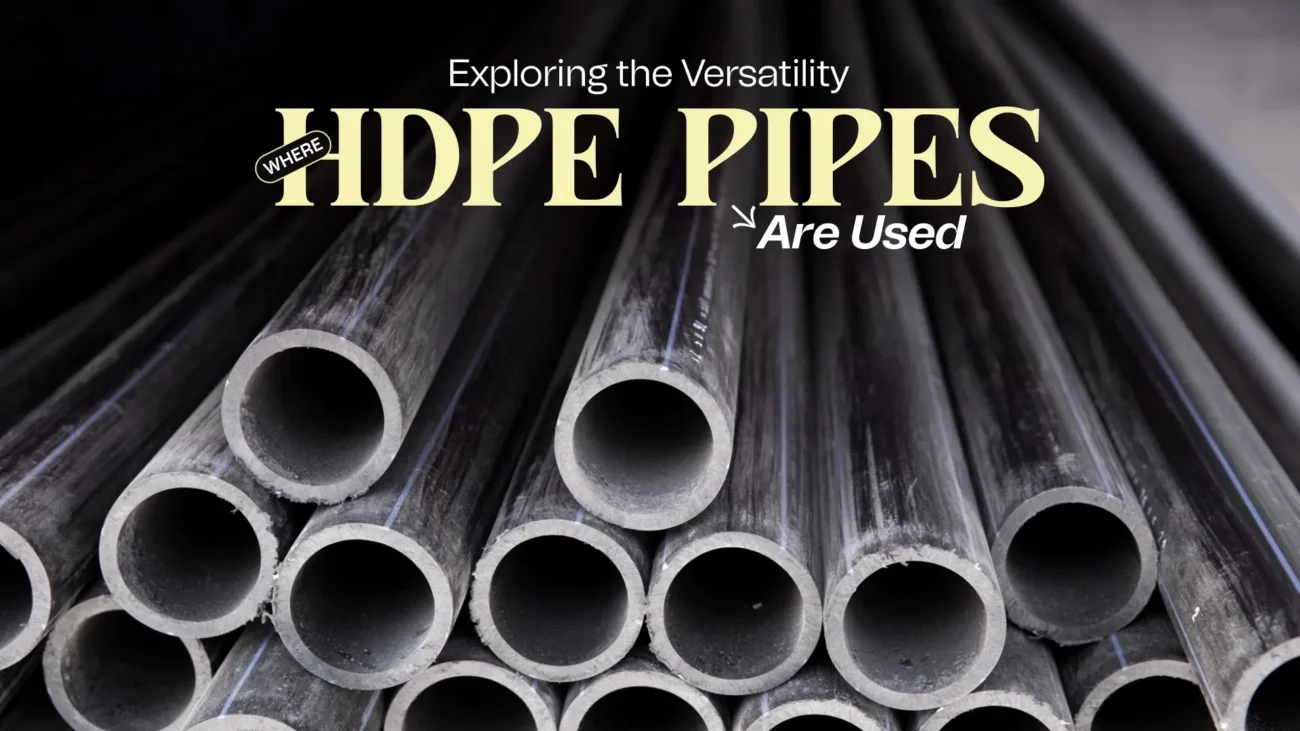


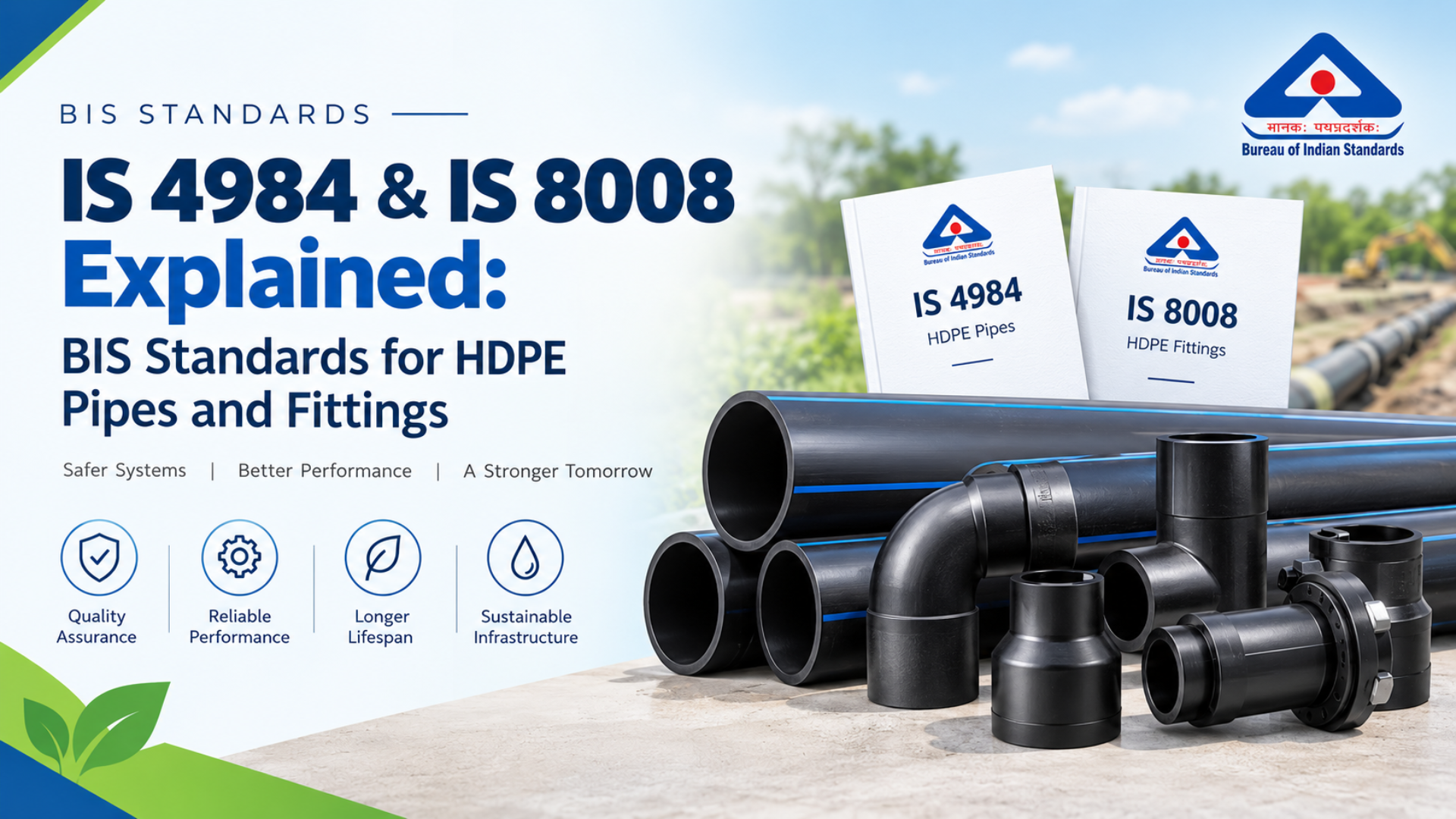
A tender says “HDPE pipes to IS 4984 and fittings to IS 8008.” The supplier says everything complies. Then a butt-fusion joint fails a pressure test and nobody can say whose part was wrong. This guide explains what IS 4984 and IS 8008 actually cover, how they fit together, and what to check on site before a single joint is made.
What are IS 4984 and IS 8008?
IS 4984 is the Bureau of Indian Standards (BIS) specification for polyethylene pipes used in water supply. IS 8008 is the BIS specification for injection-moulded and machined HDPE fittings used with those pipes in potable water systems. In short: IS 4984 covers the pipe, IS 8008 covers the moulded fittings that join it.
They’re written to work as a pair. IS 8008 refers back to IS 4984 for pipe dimensions and for its hydraulic test method, so a fitting to IS 8008 is designed to match a pipe to IS 4984 of the same size and pressure class.
| IS 4984 | IS 8008 | |
| Covers | Polyethylene pipes for water supply | Injection-moulded / machined HDPE fittings for potable water |
| Current version | IS 4984:2016 (fifth revision) | IS 8008 Parts 1–9, 2003 revision |
| Material grades | PE 63, PE 80, PE 100 | PE 63, PE 80, PE 100 |
| Size range | DN 16 mm to DN 2000 mm | 20 mm to 1000 mm |
| Structure | One standard | Part 1 (general requirements) + Parts 2–9 (specific fittings) |
What does IS 4984 specify for HDPE pipes?
IS 4984:2016 sets the material, dimensions, pressure classes and tests for PE pipes carrying water. According to the BIS product manual for IS 4984, it covers three material grades (PE 63, PE 80 and PE 100), sizes from DN 16 mm to DN 2000 mm, and twelve pressure classes: PN 2, 2.5, 3, 3.2, 4, 5, 6, 8, 10, 12.5, 16 and 20.
PE 63 vs PE 80 vs PE 100
The number after “PE” comes from the material’s Minimum Required Strength (MRS). PE 100 has an MRS of 10 MPa, PE 80 has 8 MPa, and PE 63 has 6.3 MPa. A stronger grade can carry the same pressure with a thinner wall.
For new water-supply work, PE 100 is usually the better buy. You get the same pressure class with less plastic, a lighter pipe and a larger bore for the same outside diameter. PE 80 still appears in older specifications and some smaller projects, so read the tender carefully.
What SDR and PN mean on an IS 4984 pipe
SDR (Standard Dimension Ratio) is the pipe’s outside diameter divided by its wall thickness. A lower SDR means a thicker wall. PN (nominal pressure) is the pipe’s rated working pressure in bar.
The two are linked through the material grade. For the same SDR, a PE 100 pipe carries a higher pressure class than a PE 80 pipe. That’s why you can’t read a pipe’s pressure rating from its SDR alone. Always check the PN and grade printed on the pipe against the manufacturer’s IS 4984 table.
Tests an IS 4984 pipe must pass
The BIS scheme for IS 4984 lists regular tests that licensed manufacturers carry out, including:
- Hydrostatic (internal pressure) tests at 27 °C and 80 °C for set durations
- Melt flow rate and density checks on the material
- Carbon black content and dispersion, which protect the pipe from sunlight
- Oxidation induction time (OIT), a measure of long-term resistance to ageing
- Longitudinal reversion, elongation at break and slow crack growth
- Overall migration, which checks that the pipe is safe for drinking water
You won’t repeat these on site. But if a supplier can’t produce recent test certificates for the batch you’re buying, treat that as a warning.
What does IS 8008 cover for HDPE fittings?
IS 8008 covers injection-moulded and machined HDPE fittings for potable water, in nine parts. Part 1 sets the general rules for material, manufacture, testing and marking. Parts 2 to 9 each cover one fitting type.
| Part | Fitting covered |
| IS 8008 (Part 1) | General requirements for all fittings |
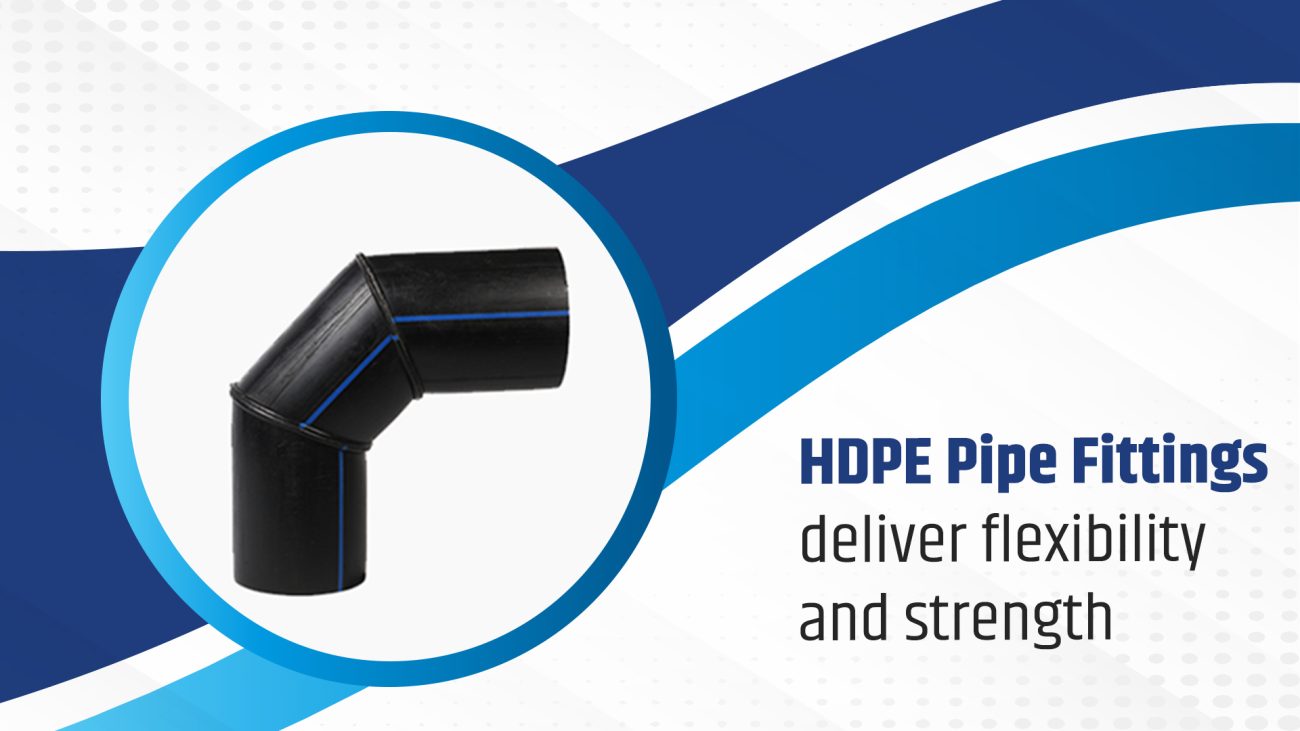
| IS 8008 (Part 2) | 90° bends |
| IS 8008 (Part 3) | 90° tees |
| IS 8008 (Part 4) | Reducers |
| IS 8008 (Part 5) | Ferrule reducers |
| IS 8008 (Part 6) | Pipe ends (stub ends) |
| IS 8008 (Part 7) | Sandwich flanges |
| IS 8008 (Part 8) | Reducing tees |
| IS 8008 (Part 9) | End caps |
Part 1 requires fittings to be made from virgin PE 63, PE 80 or PE 100 material and to pass a hydraulic test using the method in IS 4984. Every fitting must be marked with the manufacturer’s identification, size, material grade and working pressure.
IS 8008 vs IS 8360: moulded or fabricated?
This is where many site teams get confused. IS 8008 covers moulded (and machined) fittings. Fittings fabricated from pipe, such as mitred bends and segmented tees welded from pipe lengths, fall under a separate standard, IS 8360.
Moulded fittings are made in one piece, so wall thickness and geometry are consistent from one fitting to the next. For small and medium sizes, a moulded fitting is usually the more reliable choice. Fabricated fittings make sense in large diameters, where moulds aren’t practical.
Which other standards will you see alongside IS 4984 and IS 8008?
On pipeline drawings and tenders, these usually appear together:
- IS 7328: the polyethylene material itself, for moulding and extrusion
- IS 8360: fabricated HDPE fittings for potable water
- IS 14885: polyethylene pipes for gas supply (not for water)
- IS 14151: sprinkler irrigation equipment, including quick-coupled HDPE pipes
- ISO 4427: the international standard for PE water pipes, often quoted in export and consultant specifications
How do you check IS 4984 and IS 8008 compliance on site?
Check four things on every delivery: the ISI mark with a valid CM/L licence number, the printed grade and pressure class, a matching SDR between pipe and fitting, and batch test certificates. This takes ten minutes and saves days of rework.
- Verify the licence. The ISI mark should carry the IS number and a CM/L number. Enter the CM/L number in the free BIS Care app to confirm the licence is valid and covers that exact product.
- Read the marking. Pipes and fittings should show the manufacturer, size, PE grade and pressure class. If any of these are missing or smudged, reject the lot.
- Match pipe and fitting. For butt fusion, the fitting’s spigot must have the same outside diameter and SDR as the pipe. A PN 10 fitting on a PN 16 line becomes the weakest point in the system.
- Ask for test certificates. Request the manufacturer’s test report for the batch, and keep it with your measurement book.
A common mistake is checking the pipe carefully and treating fittings as an afterthought. A pipeline is only as strong as its weakest joint, and that joint is usually a fitting.
Frequently asked questions
What is IS 4984?
IS 4984 is the Bureau of Indian Standards specification for polyethylene pipes for water supply. The current version, IS 4984:2016, covers PE 63, PE 80 and PE 100 pipes from DN 16 mm to DN 2000 mm in pressure classes from PN 2 to PN 20.
What is IS 8008?
IS 8008 is the Bureau of Indian Standards specification for injection-moulded and machined HDPE fittings for potable water supply. It has nine parts: general requirements, then bends, tees, reducers, ferrule reducers, pipe ends, sandwich flanges, reducing tees and end caps.
What is the difference between IS 8008 and IS 8360?
IS 8008 covers HDPE fittings that are injection-moulded or machined. IS 8360 covers HDPE fittings fabricated from pipe, such as mitred bends and segmented tees.
Is PE 100 better than PE 80?
PE 100 has a higher Minimum Required Strength (10 MPa vs 8 MPa), so it can carry the same pressure with a thinner wall. For most new water-supply projects, PE 100 gives a lighter pipe and a larger bore for the same outside diameter.
How do I check if an HDPE pipe or fitting is really ISI-certified?
Find the CM/L licence number printed next to the ISI mark and enter it in the BIS Care app. The app shows whether the licence is valid, who holds it and which Indian Standard it covers.
Build to the standard, then check it
IS 4984 and IS 8008 give you a common language with suppliers, consultants and inspectors. Use it: write the grade, PN and SDR into every purchase order, and check them on every delivery. Arihant Plast manufactures HDPE pipe fittings at its factory in Jaipur and has supplied contractors since 1998. For fittings that match your pipe’s grade and pressure class, call 9829010745 or email info@arihantplast.in.